
For the serious golfer, a trip to The Greenbrier Resort in the Allegheny Mountains of West Virginia is more than a standard getaway; it is a pilgrimage to one of the most storied cathedrals of American sport. While many visit for the “Old White” package, they stay for the chance to walk the same fairways where Sam Snead, the “Slammin’ Sammy” himself, built a legacy that is still palpable today.
The Grand Dame of American Resorts
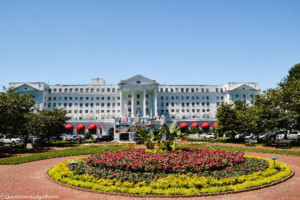
The hotel, a National Historic Landmark, has hosted 28 U.S. Presidents and remains the gold standard for “old-school” luxury. Redecorated in 1948 by the legendary Dorothy Draper, the interior is a masterclass in Modern Baroque design. Its vibrant floral patterns, high ceilings, and bold colors create a regal atmosphere that feels both historic and impeccably maintained. The resort is a sprawling 720-room sanctuary, offering everything from a world-class casino to subterranean Cold War bunkers, all while maintaining a level of service that harkens back to a more elegant era of travel.
Sam Snead: The Soul of The Greenbrier
No name is more synonymous with the resort than Sam Snead. His connection to the property began in 1936 as an assistant professional, eventually serving as the head golf professional from 1946 to 1974. He returned in 1993 as the Golf Professional Emeritus, a title he held until his passing in 2002. The clubhouse serves as a living shrine to his 82 PGA Tour victories. Visitors should not miss the Champions Room and the Sam Snead Museum, a dedicated display featuring an extraordinary collection of memorabilia. Here, you can stand inches away from his Masters Green Jacket, his Open Championship Claret Jug, and his Ryder Cup captain’s jacket. It is a rare, intimate look at a titan of the game. Snead’s presence is even etched into the course itself; he famously recorded his 42nd and final career hole-in-one on the 18th hole of The Old White.
Architectural Mastery and Exquisite Conditioning
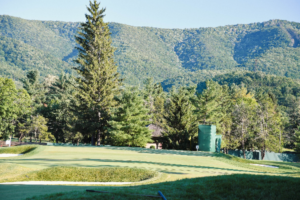
The Old White remains the centerpiece of the resort’s five courses. As the first 18-hole design by C.B. Macdonald, it is a living museum of “template holes.” The conditioning today is nothing short of exquisite. Following a 2017 restoration, the bentgrass fairways are kept at a championship density that provides the firm, tight lies preferred by low handicappers. The greens are meticulously groomed to run fast and true, rewarding those who can read the subtle undulations of the Allegheny terrain.
While the course hosted the 1979 Ryder Cup and the 1994 Solheim Cup, it remains a premier venue for modern competition, currently serving as a featured stop for LIV Golf.
Featured Hole: No. 3 – The Biarritz
The pinnacle of the round is Hole No. 3, a 197-yard par 3 known as the Biarritz. This template hole is a grueling test of distance control. The massive green is bisected by a deep, four-foot swale—the “valley of sin”—that runs horizontally across the surface. A player must decide whether to carry the ball to the back tier or use the contours to run it through the trench. If your tee shot finds the wrong tier, you are faced with a treacherous putt that must climb a steep incline, requiring absolute commitment to pace and line.
A Legacy Preserved
Between the meticulous grooming of the fairways and the echoes of legends in the clubhouse, The Old White is a masterclass in architectural integrity and historical reverence. It remains an essential destination for any golfer who appreciates the intersection of classic design and the enduring spirit of Sam Snead.
Find other high-resolution photos at:
www.quintessentialgolf.com/destinations/waldorf-astoria-golf-club
By Chuck Fox, Owner, Quintessential Golf, Resident since 2012