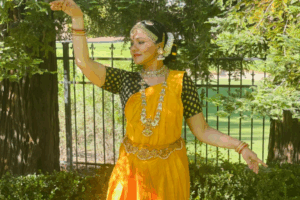
Bharatanatyam and medicine might seem like two separate worlds. For Blackhawk resident Dr. Shobana Vankipuram, they are parallel paths that meet at the same place: service, discipline, and connection.
Finding home in Blackhawk
Shobana has called Blackhawk home for a few years. She was drawn by the warmth, diversity, and strong sense of community. It is a place where her dual callings as a physician and Bharatanatyam dancer can flourish. “The community’s openness to cultural experiences makes it possible to share this art in meaningful ways,” she says.
An early spark that never faded
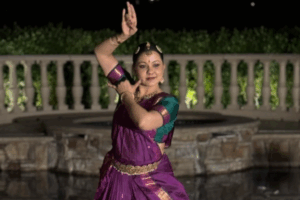
Her artistic journey began at age four, inspired by a grandmother devoted to Carnatic music and the veena. Dance paused at times for academics and family, yet the passion stayed. Over the last decade, Shobana has returned to intensive training and now studies with her guru, Shobana Bhalchandra. “Art and medicine are two paths of empowerment,” she says. “Each enriches life and invites healing at a deep level.”
What is Bharatanatyam
Bharatanatyam is one of India’s oldest classical dance forms. It began in temples as a devotional offering, set to Carnatic music with intricate rhythms, graceful geometry, and expressive storytelling. Rooted in tradition, it continues to evolve and speak to audiences around the world.
Teacher, mentor, bridge-builder
Through her school, Tejasvi Natyalaya, named after her daughter Tejasvi (Tejasvi means “radiant,” Natyalaya means “house of dance”), Shobana teaches more than technique. She aims to create a studio where tradition and empowerment meet, where each dancer’s voice can shine. “The most rewarding part is watching quiet transformations,” she says. “Discipline and expression build confidence from the inside out.”
Medicine and dance, working together
Balancing clinic hours with rehearsals is demanding. Shobana manages it by seeing both roles as complementary. Medicine heals the body. Dance nourishes the spirit. The focus and listening she practices with patients flow naturally into her teaching and performance. “Both require empathy, observation, and the ability to connect,” she explains.
Community threads
Blackhawk has shaped her journey in tangible ways. Shobana has shared Bharatanatyam at the Garden Club luncheon and at the community’s Diwali celebrations. Tejasvi Natyalaya has hosted a local workshop and performed across the Tri-Valley, including the Hayward World Dance Festival. These moments bring artists, students, and audiences together for cultural dialogue.
What is next
This year brings a full calendar: the RAW showcase at Safehouse Arts in San Francisco in October, the school’s first annual day celebration at the Front Row Theater in November, a dance presentation for the national AAPIO gala in San Francisco in November ( American Association Of Physicians of Indian Origin) and a women-centric fundraiser concert for Narika in March 2026. Narika’s mission of empowering women is close to Shobana’s heart. She has served on the organization’s board and continues to support its work.
Looking ahead, she plans annual showcases, cross-cultural collaborations, and outreach that doubles as a living classroom. Students will study and present iconic choreographies by the Tanjore Quartet, lyrical works of Maharaja Swati Thirunal, and expressive pieces such as javalis and padams. They will share research on history, poetry, and storytelling traditions to help audiences see how Bharatanatyam has traveled from sacred temple floors to royal courts to international stages.
Anchors and inspiration
Shobana credits her grandmother for opening the door to the arts, and her guru for continued guidance. She also honors her husband, Ananth Balasubramanian, for steady support that makes both medicine and dance possible. Their children, Tejasvi (13), also a budding dancer and Nandan, a budding cricketer (11), keep life joyful and grounded. For creative reset, she walks the neighborhood, letting silence and nature shape new choreography.
Values to live by
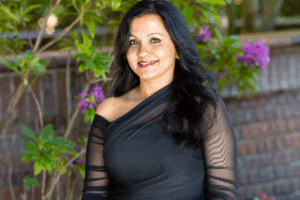
Integrity, compassion, and lifelong learning guide her work in the clinic and the studio. Her advice to young people who love both science and art is simple. You do not have to choose. With passion, discipline, and structure, you can excel in both. Each one will make you stronger in the other.
By Megan Scott, Resident since 2010