
You don’t casually stroll onto Bethpage Black. You earn your day here—whether that’s by navigating the famously competitive online reservation system or, in my case, rolling up at 6am like a pilgrim on a sacred journey. In late May, luck was with me: a single spot at 7:30 am.
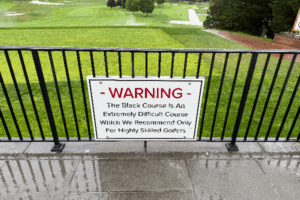
On the opening tee, the tone is set:
WARNING – The Black Course is An Extremely Difficult
Course Which We Recommend Only for Highly Skilled Golfers.
It’s truth, delivered without sugarcoating, as only New Yorkers can. The course is owned and operated by the New York City Parks Department, part of the sprawling Bethpage State Park golf complex that boasts five courses. But the Black is the crown jewel—a municipal track in name only, its conditioning rivaling that of private clubs.
If you follow championship golf, you know the Black’s résumé. It hosted the 2002 and 2009 U.S. Opens. It staged the 2019 PGA Championship and, come September 2025, the Ryder Cup will arrive.
One of the course’s most traditional quirks: golf carts are prohibited. Walking is mandatory, though pushcarts are available. Even with one, you’ll feel the Black’s rolling terrain in your legs by the back nine. It’s a proper, physical round of golf—no shortcuts, no easy rides.
The conditioning is impeccable. Fairways are lush and tightly mown, greens roll true, and tees are manicured to perfection.
The Rough Reality
Standing on the first tee, you’re immediately met with a harrowing visual – narrow swath of perfectly straight fairway surrounded by thick dark green rough.
The Black’s defining defense is this rough: thick, penal, and relentless. It doesn’t just grab your ball—it swallows it whole, demanding a heroic recovery or a humble pitch-out. A miss off the tee here isn’t just an inconvenience; it’s a 0.5 to full stroke lost, minimum.
Combine that with narrow fairways bordered by mature trees, and driving becomes a high-pressure exercise in precision. You don’t simply “play” the Black; you survive it. Every tee shot demands commitment, and every decision feels weighted with consequence.
The greens at Bethpage Black are small to medium in size—nothing overly undulating, but their compact nature means approaches need to be accurate. The subtle breaks are enough to punish lazy reads, and with the Black’s firm conditions, holding a green from the rough can feel like threading a needle with a garden hose.
Approaches from the fairway are rewarded, often with birdie chances that tempt you into believing the Black is softening. It isn’t. The moment you relax, the rough or a strategically placed bunker will remind you exactly where you are.
From the White tees, the course still plays like a championship test. I managed to keep my drives mostly in the short grass, and when I did find the rough, I took my medicine. The fairways rewarded me with clear looks at pins, and the greens held just enough to allow controlled approaches.
By the time I walked up 18, legs heavy from the hills and mind
sharpened by 17 holes of decision-making, I knew I had played well.
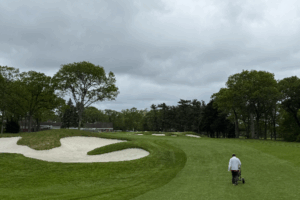
An up-and-down for par capped off an 80—no small feat for a non-resident who just hours earlier had been praying for a tee time in the parking lot.
The Verdict
Bethpage Black is golf without pretense. It’s a municipal course where your greens fee buys you a shot at the same challenge faced
by Tiger Woods, Brooks Koepka, and soon, the Ryder Cup elite. The layout is fair but uncompromising, the walk is grueling but satisfying, and the sense of accomplishment is unmatched.
If you’re a skilled player looking for a true test—and you don’t mind earning it on foot—Bethpage Black belongs on your bucket list. Just remember: the sign at the first tee isn’t there for decoration.
By Chuck Fox, Owner, Quintessential Golf, Resident since 2012